
8.2.1How do the shells fit?
Shell Lab
- Problem 8-60 did not suggest adding washers or disks to determine the volume of the largest matryoshka doll. Instead, what volumes were added?
- In problem 8-61, what did Joshua add together to determine the area of his circle?
- When we have calculated area by using an integral, we have used the typical rectangle to help determine the values that form the integral. What dimensions did Joshua use to determine his rectangle?
SHELL LAB
Choose a set of functions and line A, B, or C from its corresponding row in the table. For example, you might choose 4B, 2C, or 3A. No two teams should choose the same set of functions with the same line. Tell your teacher your choice before you start to verify that no other team has chosen your set of functions.
Region Enclosed by These Functions | About line A | About line B | About line C |
|---|---|---|---|
1. | A. | B. | C. |
2. | A. | B. | C. |
3. | A. | B. | C. |
4. | A. | B. | C. |
Cut out rectangles for the shells based on the height and the circumference in your table. The width of each rectangle is the height of each shell. Tape each rectangle so that the shell looks circular when you tape. Then assemble your solid of revolution.
Write the integral to represent the volume of your solid and use a graphing calculator to compute the volume. Be prepared to share your method with the class.
Radius | Height | Circumference |
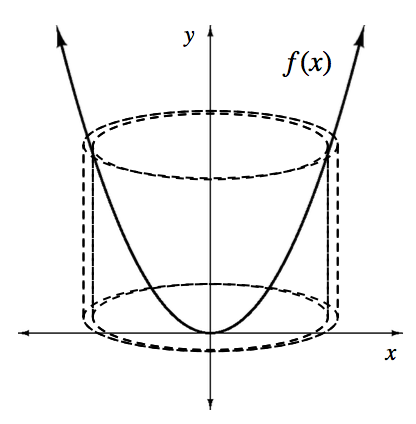
Up to this point, we have mostly used disks and washers to calculate the volume of a solid of revolution. This time, we will use cylindrical shells to calculate the volume instead.
A cylindrical shell is only the lateral wall of a cylinder. But, when flattened, each shell becomes a rectangular prism with a thickness
If the shell is unrolled, what shape will it be? Name its dimensions.
If the thickness of the shell is
, write an expression for the volume of this generic shell. Write an expression that will accumulate the volumes of the cylindrical shells and calculate the exact volume of the solid of revolution.
.png)
and , use the cylindrical shells method to calculate the exact volume of the rotated solid. Compare your results to the Shell Lab completed in problem 8-66. Was your result from problem 8-66 close?

Write an equation for
;
Examine the integrals below. Consider the multiple tools available for evaluating integrals and use the best strategy for each. Evaluate each integral and briefly describe your method. Homework Help ✎
Multiple Choice: The volume generated by revolving the region enclosed by the graphs of
Multiple Choice: The graph of
A vertical asymptote at
. A horizontal asymptote at
. An infinite number of zeros.
I only
II only
III only
II & III only
I, II, & III
.png)
The domain of the derivative of
is the open interval . is continuous on the open interval . The derivative of
is positive on the open interval .
I only
II only
III only
II & III only
I, II, & III
Multiple Choice: If the line


